The Art of Natural Cheesemaking by David Asher
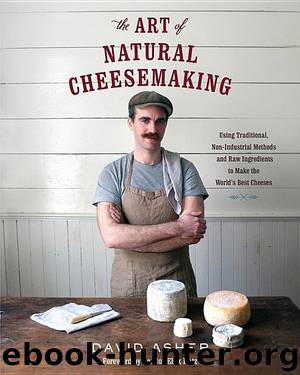
Author:David Asher
Language: eng
Format: epub, azw3
Publisher: Chelsea Green
Published: 2015-06-16T05:36:23+00:00
Soft and creamy chèvre curd made with a light dose of rennet and kefir culture, visible floating atop the curd in the top right of the pot.
Soft at Heart
Chèvre, just like a milking doe, is a soft and friendly cheese. It is mainly the dose of rennet added to the milk that makes it so.
One of the most important differences between soft and hard cheeses is the amount of rennet used. Semi-firm cheeses such as Camembert and blue cheese have a regular dose of rennet; firm cheeses, such as Alpine cheeses, use a double dose of rennet; and chèvre, the softest rennet cheese, involves adding just enough rennet to make the curd set.
Chèvre is a soft, smooth cheese; using a full dose of rennet will yield a chunky result. The rennet dose greatly affects the texture of the chèvre, and a greater dose of rennet will make a cheese firmer. However, it’s not just the rennet dose that matters but also the quality of the goats’ milk. Well-raised, pastured raw goats’ milk will form a very nice curd with a tiny, almost homeopathic dose of rennet: just one-quarter of a regular dose. However, pasteurized goats’ milk, or milk from goats that do not get much browse, needs a slightly higher dose of rennet to form good curds. It may take a few tries to get the rennet dose right: It’s difficult to measure such a small rennet dosage, especially when making small batches of chèvre.
Slow Fermentation
Goats’ milk responds beautifully to the slow fermentation it receives during chèvre-making. The unique fats in goats’ milk, when subjected to a long fermentation period, break down into particular fatty acids that give chèvre much more flavor than a similar cheese made with cows’ milk.
To encourage a slow fermentation, chèvre-makers use lower temperatures than are employed for other rennet cheeses. To begin, the milk is warmed to udder temperature to ensure rennet coagulation. Once the rennet and culture are added to the milk, the fermenting milk is allowed to cool to room temperature, thus slowing the fermentation.
Let the pot of milk ripen at room temperature for a day or longer: The longer you let the goats’ milk ferment, the better your chèvre will taste. Don’t wait too long, though, as a film of white fungus that originates in raw milk or kefir may begin to grow atop the whey in the pot after a few days. If, however, you are making certain types of fungally aged chèvres ( see chapter 12 ), the fungal development that occurs after several days’ fermentation can help to ensure an even growth of the cheese’s fungal coat!
Download
The Art of Natural Cheesemaking by David Asher.azw3
This site does not store any files on its server. We only index and link to content provided by other sites. Please contact the content providers to delete copyright contents if any and email us, we'll remove relevant links or contents immediately.
The Brazilian Economy since the Great Financial Crisis of 20072008 by Philip Arestis Carolina Troncoso Baltar & Daniela Magalhães Prates(310373)
International Integration of the Brazilian Economy by Elias C. Grivoyannis(111319)
The Art of Coaching by Elena Aguilar(53422)
Flexible Working by Dale Gemma;(23320)
How to Stop Living Paycheck to Paycheck by Avery Breyer(19779)
Thinking, Fast and Slow by Kahneman Daniel(12422)
The Acquirer's Multiple: How the Billionaire Contrarians of Deep Value Beat the Market by Tobias Carlisle(12379)
The Radium Girls by Kate Moore(12094)
The Art of Thinking Clearly by Rolf Dobelli(10598)
Hit Refresh by Satya Nadella(9192)
The Compound Effect by Darren Hardy(9056)
Tools of Titans by Timothy Ferriss(8494)
Atomic Habits: Tiny Changes, Remarkable Results by James Clear(8415)
Turbulence by E. J. Noyes(8114)
A Court of Wings and Ruin by Sarah J. Maas(7950)
Change Your Questions, Change Your Life by Marilee Adams(7847)
Nudge - Improving Decisions about Health, Wealth, and Happiness by Thaler Sunstein(7758)
How to Be a Bawse: A Guide to Conquering Life by Lilly Singh(7548)
Win Bigly by Scott Adams(7266)
